
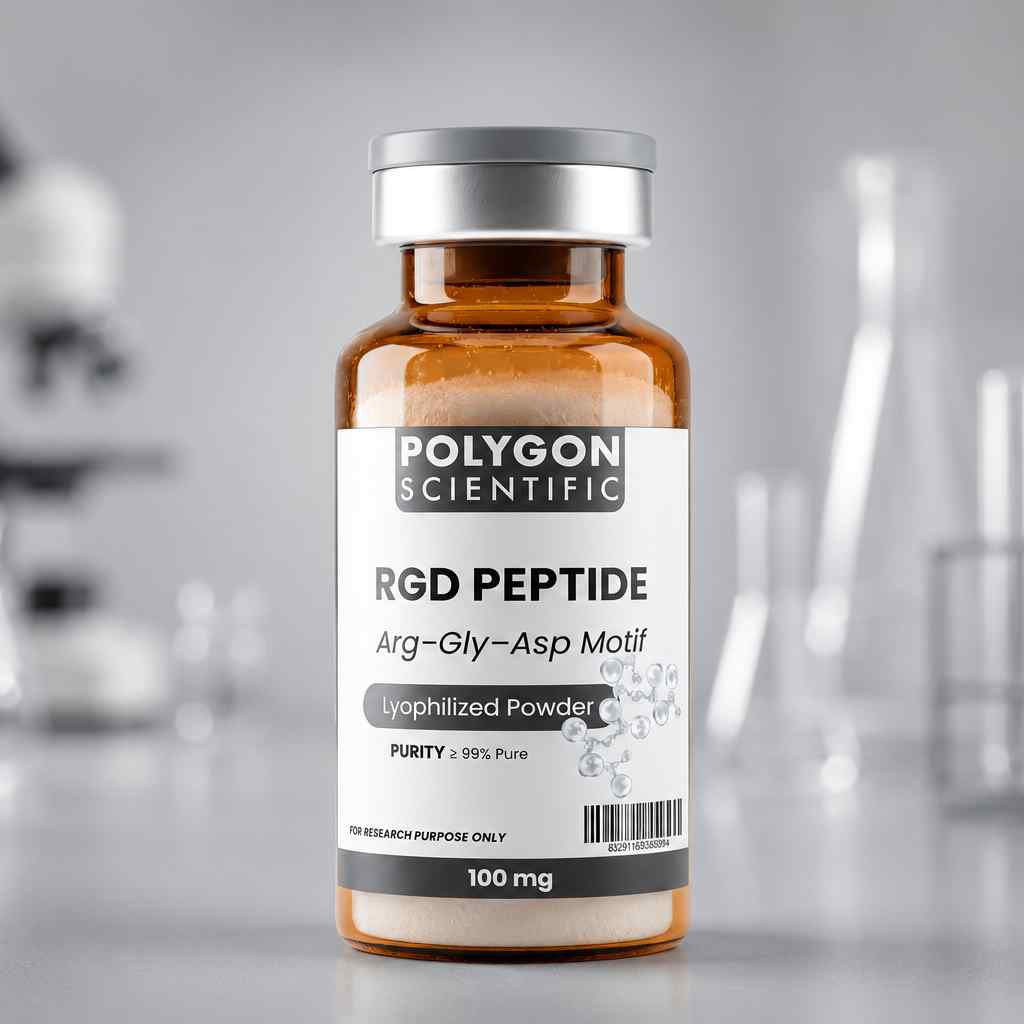
RGD (Arg-Gly-Asp) tripeptide is the universal integrin-binding motif present in fibronectin, vitronectin, osteopontin, fibrinogen, and bone sialoprotein. As a research-grade integrin ligand (MW 346 Da; ≥98% purity), RGD is a cornerstone research tool for cell adhesion biology, targeted cancer therapy delivery, integrin pharmacology, 3D tissue engineering scaffold functionalisation, and stem cell microenvironment engineering — with one of the broadest translational research footprints of any synthetic tripeptide. RGD is the core recognition sequence for integrins αvβ3, α5β1, and αIIbβ3.
Advanced Research Applications:
Key Technical Specifications
|
Peptide Name |
RGD (Arg-Gly-Asp) |
|
INCI / Common Name |
Arginine-Glycine-Aspartic Acid Motif |
|
Sequence |
H-Arg-Gly-Asp-OH |
|
Molecular Weight |
346 Da |
|
Purity |
≥98–99% by RP-HPLC |
|
Primary Integrin Targets |
αvβ3, αvβ5, α5β1, αvβ6, αIIbβ3 |
|
Mechanism |
MIDAS-coordinated integrin binding → FAK Tyr397 |
|
Key Research Areas |
Cancer Targeting, Drug Delivery, Tissue Engineering, Stem Cell |
|
Form |
Lyophilized Powder |
|
Solubility |
Freely soluble in water (≥50 mg/mL) and PBS at physiological |
|
Storage |
−20°C, desiccated, dark; stable ≥24 months when stored |
|
CAT Number |
PS-SYN-SIG-004 |

Polygon Scientific delivers reliable biotechnology and advanced formulations, creating research-driven, sustainable solutions that transform science into real-world impact.